May 2026: Falcon launches fUSD with Anchorage, giving institutional holders access to rewards targeting 3% annually
Published • 2 Jun 2026
4 mins
.jpg%3Fprefix%3Dmedia&w=3840&q=75)
May was about regulated dollars meeting institutional collateral rails. We launched fUSD with Anchorage Digital Bank, N.A., the first federally chartered crypto bank in the U.S., and brought it to market on Ceffu's institutional custody and collateral infrastructure.
fUSD is built for desks that need a compliant, bank-issued dollar but still care about the economics of the reserves behind it. It is GENIUS-ready, backed 1:1 by cash, short-dated U.S. Treasuries, and Treasury-backed repo, with reserves under OCC supervision and monthly attestations by Deloitte. Qualifying institutional holders can also participate in a Falcon-operated rewards program targeting roughly 3% per year, offered separately from Anchorage as issuer and Ceffu as custodian.
USDf continues to serve DeFi-native and multi-collateral use cases, while fUSD extends Falcon's reach to federally regulated treasury desks, compliance-constrained counterparties, and institutional collateral mandates that require a non-synthetic dollar.
USDf & sUSDf Updates
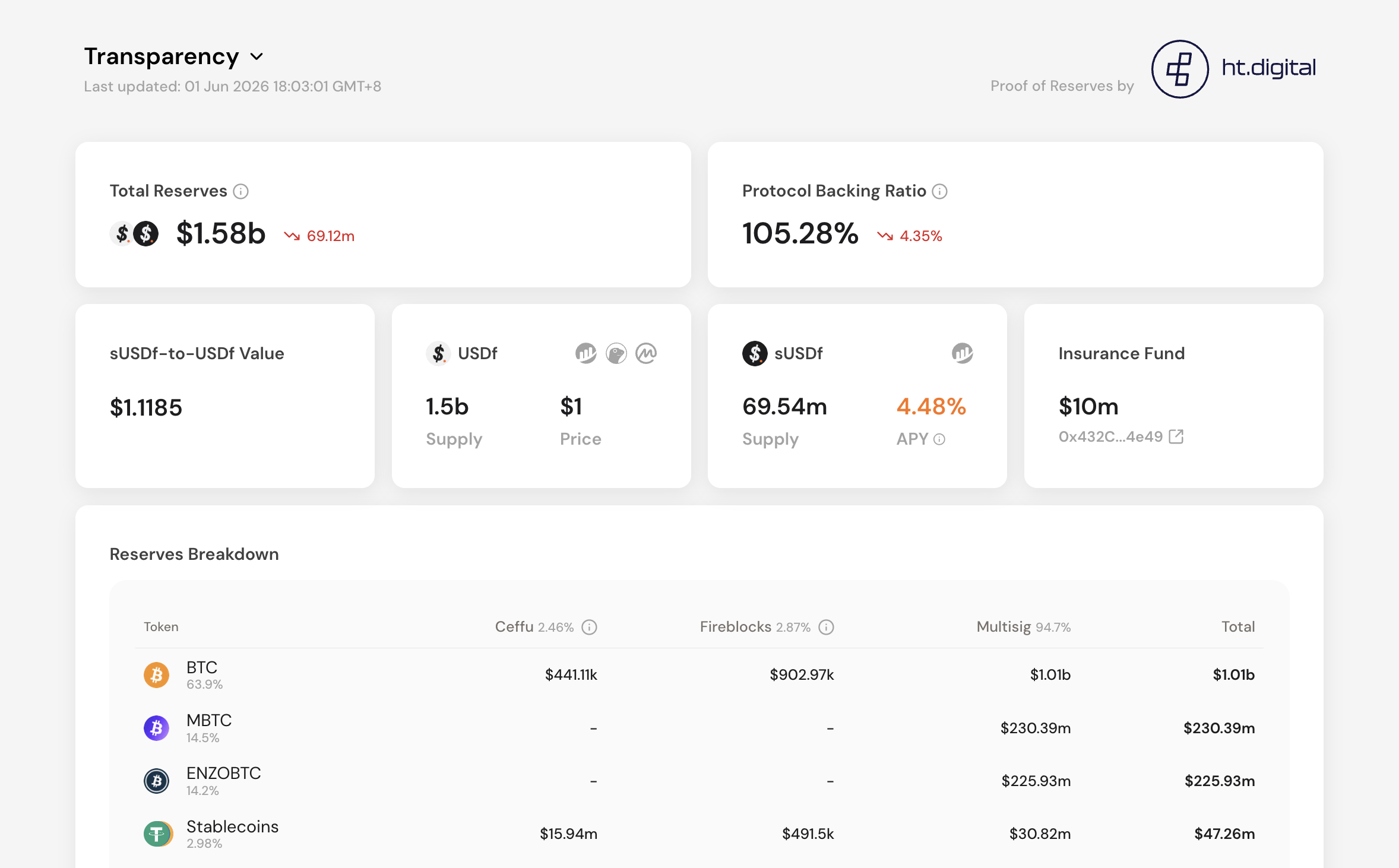
As of the live dashboard capture on June 1, USDf supply sits at $1.5 billion, with $69.84 million in sUSDf. Total reserves are $1.59 billion, putting the protocol backing ratio at 105.8%.
sUSDf is delivering 4.69% APY, supported by a $10 million insurance fund and HT Digital's latest attestation dated May 25.
A few more details worth keeping close:
- Reserve exposure remains led by BTC at 64% ($1.02 billion), followed by mBTC at 14.6% and enzoBTC at 14.3%.
- Yield generation is still anchored by options-based strategies at 61%, with positive funding farming and staking at 21%.
- USDf reached roughly $1.78 billion in mid-May community updates, showing continued demand for collateralized dollar liquidity.
Key Announcements
fUSD launches with Anchorage Digital Bank and Ceffu
On May 27, Falcon Finance launched fUSD, a GENIUS Act-ready stablecoin issued by Anchorage Digital Bank, N.A., the first federally chartered crypto bank in the U.S.
fUSD is backed 1:1 by cash, short-dated U.S. Treasuries, and Treasury-backed repo, with monthly attestations by Deloitte. It launched on Ceffu's institutional custody and collateral infrastructure, giving qualifying institutional holders access to rewards targeting approximately 3% annually.
The important part is not just that another dollar asset exists. It is that fUSD sits next to USDf as a more regulated institutional rail: treasury operations, settlement, collateral movement, and compliant liquidity all in the same orbit.
Ecosystem Growth and Partnerships
Carrying the Ondo collateral thesis forward
Falcon integrated TSLAon on April 23 as its first Ondo tokenized asset, it's a live example of the collateral thesis.
The point is simple: tokenized equities become more useful when they can unlock liquidity. Users can keep exposure to the underlying asset while minting USDf against it, turning static exposure into something composable.
Chainlink and infrastructure partners
Falcon also celebrated Chainlink's 7th anniversary, recognizing its role in securing DeFi, stablecoins, tokenized assets, and cross-chain infrastructure.
Community
X announced the closure of Communities on May 30, so Falcon began moving primary discussion back to Telegram and Discord. Remember to follow our official links, be careful with imposters, and keep the conversation in channels the team can actively maintain. (Here's Falcon Finance's X account.)
Insights, Media and AMAs
fUSD coverage
Cointelegraph, PaySpace Magazine, Traders Union, and other outlets covered the fUSD launch with Anchorage Digital. The coverage focused on its GENIUS Act-ready structure, institutional rewards target, Ceffu deployment, and the broader idea of returning reserve yield to qualifying holders.
Read the Cointelegraph coverage: Anchorage Digital launches federally regulated stablecoin with Falcon Finance.
Andrei Grachev on market structure
Andrei Grachev joined Whitelist Media to discuss DWF Labs, Falcon Finance, DeFi risk, market making, and where crypto narratives are heading in 2026. His broader media commentary highlights the same theme: tokenized assets are growing quickly, but the bigger opportunity is making them liquid, compliant, and productive.
Artem Tolkachev on RWA composability
Artem Tolkachev's May commentary focused on the gap between the fast-growing RWA market and its still-limited use inside DeFi. Tokenized assets have crossed the $30 billion mark, but much of that value still behaves like passive exposure. The next step is composability: collateral use, better exits, deeper liquidity, and clearer settlement paths.
What's Next?
Looking ahead, the work is about connecting the two sides of the Falcon system: USDf as a universal collateralized dollar for crypto and DeFi, and fUSD as a regulated institutional rail.
The market is moving toward a world where Treasuries, tokenized equities, commodities, and other real-world assets can sit inside the same collateral stack.
With USDf and fUSD, Falcon is building for that convergence: crypto-native liquidity on one side, regulated institutional access on the other, and a broader collateral layer designed for where onchain finance is going next.
We have widened the path. Now the focus is scaling what moves through it.