September 2026: A national stablecoin becomes USDf collateral
Published • 1 Oct 2026
5 mins
.jpg%3Fprefix%3Dmedia&w=3840&q=75)
September was about putting a local-currency stablecoin to work as dollar collateral. On September 15 Kyrgyzstan’s som-pegged KGST became eligible to mint USDf through Classic Mint. The rest of the month we stayed on what you can already do: mint USDf against eligible crypto and tokenized assets, spend it on Falcon Card, and, for qualifying institutions, use fUSD. The El Salvador GPU forward is still in structuring. On September 29 we marked one year since the FF TGE, at DWF Labs Haus in Seoul.
USDf & sUSDf Updates
As of September 30, USDf supply sits at $1.21b, with $57.39m in sUSDf. Total reserves are $1.90b, putting our backing ratio at 156.47%. sUSDf is delivering 4.21% APY, supported by a $10 million insurance fund.
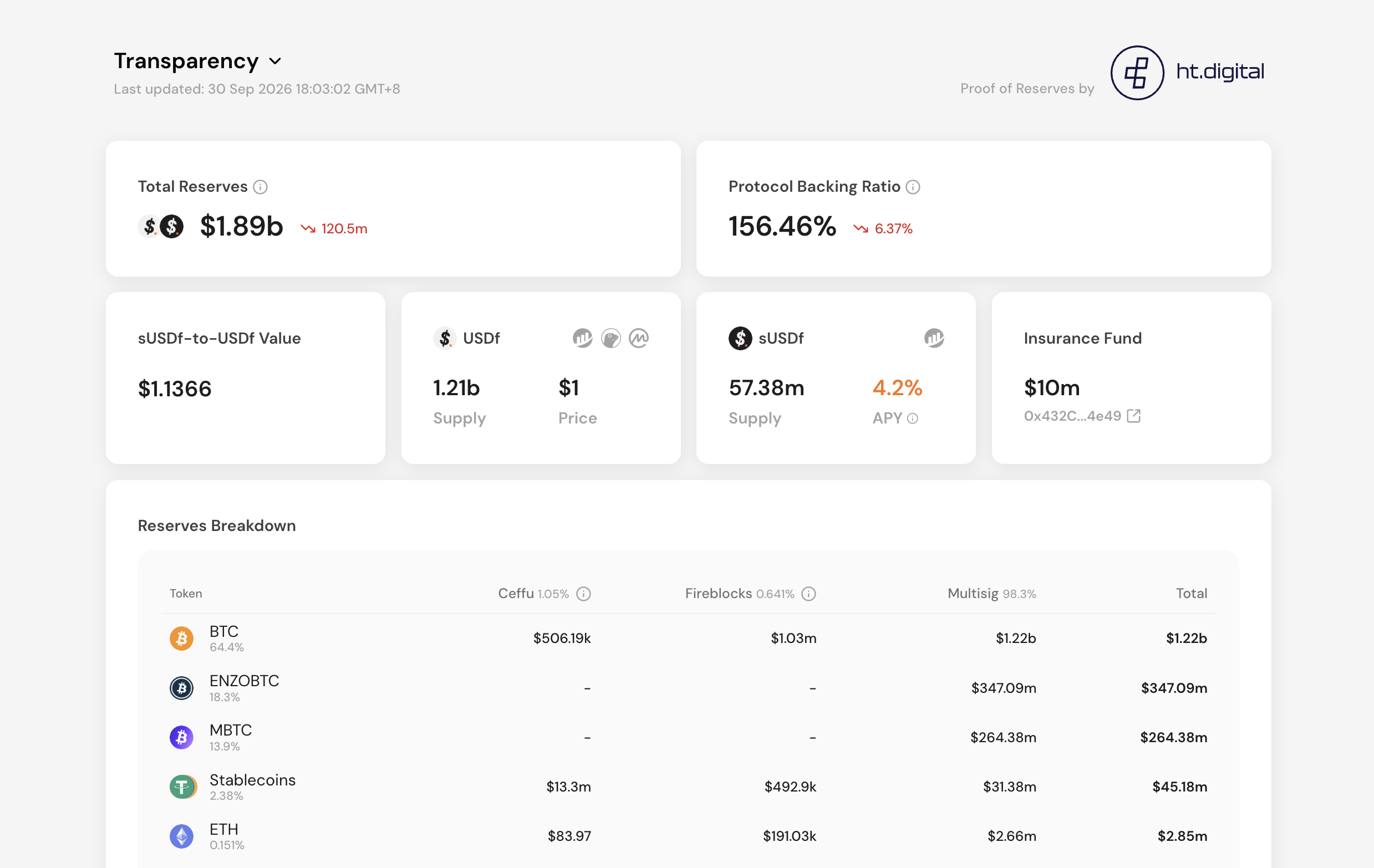
A few more details worth keeping close:
- Reserve exposure remains led by BTC at 64.38% (~$1.22b), followed by enzoBTC at 18.28%($347.09m) and mBTC at 13.93% ($264.39m), with the rest across stables and select crypto.
- sUSDf marked at $1.1366 per unit in the same capture.
- Versus the August 31 capture, supply moved from $1.18b to $1.21b, while reserves rose from $1.67b to $1.90b and backing from 141.6% to 156.47%.
Key Announcements
KGST can mint USDf through Classic Mint
On September 15 we made Kyrgyzstan’s state-backed som stablecoin, KGST, eligible to mint USDf through Classic Mint. Holders can post KGST and mint USDf, connecting local-currency value to the rest of the Falcon stack. That X post is the official announcement. Mint on app.falcon.finance.
That is the job KGST now does on Falcon: keep the som, mint the dollar.
Ecosystem Growth and Partnerships
Who issues KGST
KGST is issued by KGSToken LLC as a som-pegged BEP-20 token on BNB Chain, with KGS reserves held in licensed Kyrgyz banks under the country’s virtual-assets law. Details sit on kgstoken.kg. Falcon’s move is collateral acceptance. Eligible users mint USDf against KGST through Classic Mint, on the terms shown in the app.
fUSD is still the institutional rail
On September 16 we recapped the desk-side dollar that already sits next to USDf. fUSD is issued by Anchorage Digital Bank, N.A., designed to align with the GENIUS Act framework, with reserves in cash, short-term U.S. Treasuries, and Treasury-backed repo. Qualifying institutions can use it as trading collateral through Ceffu’s MirrorRSV, and may qualify for a separate Falcon rewards program targeting roughly 3% a year. Anchorage does not pay yield on fUSD itself. The May launch article and fusd.falcon.finance still carry the product terms.
Community
One year of FF, at Korea Blockchain Week
On September 22 we invited the community to DWF Labs Haus in Seoul on September 29 at 7 PM, during Korea Blockchain Week. On the anniversary itself we posted the celebration and, in a reply, walked the year since the September 29, 2025 TGE: collateral expanding from KAIA, XAUt, xStocks, JAAA/JTRSY, and CETES through TSLAon, dual-wrapper NVIDIA, Falcon Card, the El Salvador pipeline, and now KGST. The gachapon was the party. The list is the product.
Insights, Media and AMAs
Close to $40 billion, and that stack already mints USDf
On September 11 we said the tokenized stack was getting close to $40 billion, and that treasuries, gold, tokenized stocks, and investment-grade credit in it can already be posted on Falcon to mint USDf. Falcon Card spends that dollar. The El Salvador pipeline is how more of the credit layer gets the same path.
Artem on what actually counts as useful
Our Chief RWA Officer Artem Tolkachev spoke at EBC12 in Barcelona (16–17 September) on vaults as infrastructure for onchain asset management. The collateral questions he put on stage were practical: how fast the asset turns into cash under stress, where the token can actually be used, and how to underwrite legal claims, redemption terms, offchain custody, and markets that close while onchain trading does not. Later in the month he told crypto.news to judge usage by the product’s job. A Treasury fund that pays and redeems on time can be doing that job while it sits in a wallet. Lending collateral has to be designed for a stressed exit. Tokenization alone does not do that work.
BlackRock on compute, and the GPU forward still in structuring
On September 22 BlackRock published The Machine-Native Economy. The paper’s compute line is that standardized claims on processing capacity could become a digital-asset use case for financing and programmable settlement, with hyperscaler cloud revenues estimated above $1 trillion a year by 2030. We quoted it because that is the wait our tokenized GPU forward is built to fund. The instrument, announced in our August El Salvador article, remains in structuring, still ahead of issuance, listing, and any collateral decision.
What's Next?
The GPU forward still has to clear structuring, listing, and a liquidity bar before it can mint USDf. Issuers can keep submitting at tokenize.falcon.finance. KGST, Falcon Card, and fUSD stay live while that work happens. Reserves stay visible on the Transparency Dashboard, as always. Thank you for reading, and for building this with us.
Tags


