Unpacking Tokenized JAAA: The Upgraded Onchain Format Behind a TradFi Credit Staple
Updated • 25 Feb 2026
Published • 26 Feb 2026
7 mins

Summary
- Launched in 2020, Janus Henderson Anemoy AAA CLO Fund (JAAA) is the largest CLO ETF by AUM. Driven by demand for income with low duration risk via floating-rate coupons, it scaled to over $27 billion in total assets by February 2026, offering about 3.5% annual yield.
- Tokenized JAAA gives onchain exposure to the highest-grade CLOs, senior, floating-rate credit backed by pools of leveraged loans. The token adds the benefits of onchain holding and transfers, and improved compatibility with digital treasury and collateral workflows to the popular TradFi instrument.
- Falcon Finance integrated tokenized JAAA by accepting it as collateral for minting USDf, offering institutional clients the highest-grade structured credit for liquidity and onchain yield strategies without selling the underlying exposure.
If 2024 was the year of tokenized Treasuries, 2025-2026 is about something bigger: tokenized funds going onchain. Tokenized JAAA sits right at that turning point. It takes a familiar institutional-grade strategy, traded as an ETF in traditional finance (TradFi), and packages it in a format designed for the crypto-native world.
This article explains what tokenized JAAA is, why it became popular, what makes its onchain representation superior, and how Falcon Finance adds a new layer of utility to this financial instrument.
What Is Janus Henderson Anemoy AAA CLO Fund (JAAA) and Why It Became Popular in TradFi?
Tokenized JAAA makes more sense when you understand why its base asset became a prime ticker for CLO exposure in public markets.
Launched in 2020, Janus Henderson AAA CLO ETF is listed on NYSE Arca, and positioned to provide high-quality, floating rate CLO market exposure in the form of an exchange-traded fund (ETF). In early 2026, the fund had almost $27 billion in total net assets, and delivered an annual yield around 5%.
The fund invests primarily in AAA-rated CLO securities, in other words, the top-priority bonds issued by a CLO, a structure that bundles many floating-rate corporate loans into one pool and then issues bonds backed by the cash flows from that pool. Because JAAA focuses on the AAA bonds, investors often view it as a way to access high-grade, investment-grade debt exposure within the leveraged-loan ecosystem, rather than owning riskier loan or high-yield bond exposure directly.
Essentially, JAAA is designed to deliver current income with relatively low interest-rate sensitivity because the underlying coupons are typically floating-rate, i.e., reset as short-term rates change.
Put together, this is the ETF’s value proposition: a liquid, exchange-traded way to earn floating-rate income from a senior, AAA-rated slice of the CLO market, without taking large duration risk. That combination has made JAAA attractive to investors seeking yield and capital-preservation characteristics relative to riskier credit, as long as they accept the trade-off that it is still a credit product, meaning its price can move when credit spreads widen or when liquidity in CLO markets tightens.
What Tokenization Brings to JAAA
Tokenization is now being treated as market infrastructure: it is a new model of digital asset ownership that can improve transparency, efficiency, and accessibility. and composability across asset types. Market experts agree that tokenized fund shares become a meaningful distribution channel. According to PwC’s study, AUM of tokenized funds will grow from about $90 billion in 2024 to $715 billion by 2030. And JAAA token is one of the main drivers of that trend.
In mid-2025, Janus Henderson partnered with Centrifuge to launch the tokenized AAA CLO fund, seeded with a major institutional allocation via Grove from the Sky ecosystem. Centrifuge acted as the tokenization and fund infrastructure. Grove provided the onchain credit and allocator infrastructure to route that capital, while Sky ensured the initial capital commitment.
Tokenized JAAA builds on the same core idea: earning floating-rate income from the highest-quality slice of the CLO market, but delivers it through onchain units, tokens.
What Is Tokenized JAAA?
Tokenized JAAA is a token that represents shares in the Janus Henderson Anemoy AAA CLO Fund, designed to provide exposure to the same investment strategy associated with Janus Henderson’s JAAA (although it is not a tokenized share of the NYSE-listed JAAA ETF).
The underlying logic stays the same. The key difference lies in how investors subscribe, hold, and redeem: the JAAA token is set up with USDC as the base currency, allowing subscriptions and redemptions in USDC, with daily dealing and a few-days settlement.
In other words, investors interact in a stablecoin-denominated workflow, but the product still operates like a conventional fund in terms of dealing windows and settlement timing. Being onchain does not automatically mean instant liquidity at NAV.
Thus, tokenized JAAA delivers institutional-grade, floating-rate credit through blockchain rails, enabling simpler digital settlement, potential compatibility with onchain treasury and collateral workflows, and broader distribution to investors who operate natively in crypto, while keeping the underlying risk profile anchored in a well-understood segment of structured credit.
At the same time, the fund remains a credit product, so valuations can move when spreads widen or liquidity tightens, and the onchain wrapper adds its own considerations: stablecoin rails, transfer restrictions and compliance controls, and technology and infrastructure risk.
How JAAA Moved the Tokenized Funds Sector
After the success of the tokenized JAAA, other major players also moved to launch tokenized funds. In December 2025, J.P. Morgan Asset Management announced MONY, its first tokenized money market fund on Ethereum, aimed at qualified investors. Later same month, DTCC announced a partnership with Digital Asset to enable tokenization of DTC-custodied U.S. Treasury securities on the Canton blockchain. Currently, DTCC also works with NYSE to develop a blockchain-based platform aimed at tokenized securities trading and onchain settlement, subject to approvals.
Market Performance and Eligibility
The JAAA token has shown rapid early scaling followed by stabilization and a modest pullback: the fund ramped from near-zero in mid-2025 to roughly $1 billion through late-2025, then declined into early-2026, hitting the $726 million mark at the end of January. Token’s total value is spread between Ethereum and Avalanche C-Chain.
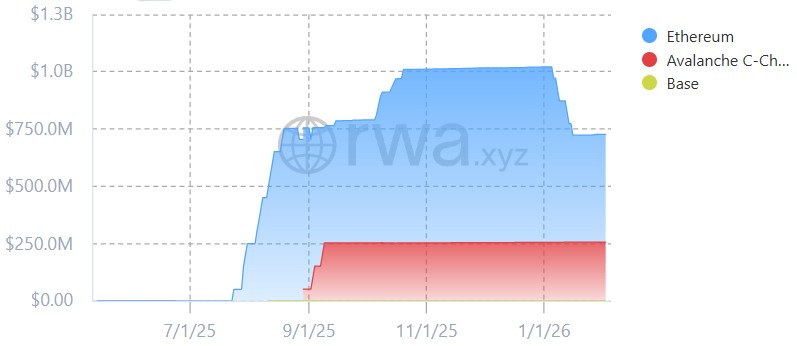
Eligible buyers are not retail investors, as the tokenized JAAA is offered to non-US professional investors. Purchases are limited to users passed through AML KYC verification, and onboarded to the Centrifuge platform. In other words, access to this onchain instrument is permissioned.
New Onchain Utility: Turning JAAA Tokens into Collateral
The most meaningful difference between a tokenized fund share and a traditional ETF share is not cosmetic — it is utility. Tokenization is often described as “putting an asset on a blockchain,” but the real shift happens when that asset can be used directly onchain as a building block for other financial actions.
A concrete example is already live: Falcon Finance now accepts Centrifuge’s JAAA token as eligible collateral to mint USDf, positioning this as one of the few real cases where a diversified AAA-rated CLO portfolio can serve as collateral. This moves structured credit from a passive holding into an asset that can be natively deployed for liquidity and yield onchain, while letting holders retain exposure rather than selling the underlying position.
Once users are onboarded to Falcon, they can deposit JAAA as collateral, mint USDf against that position, and then deploy USDf across staking, liquidity pools, or other strategies within Falcon’s broader ecosystem.
Introducing this asset to the list of eligible collateral, Falcon Finance aims at institutional investors who value onchain liquidity, capital efficiency, and compliant access to high-quality credit exposure.
Closing Thoughts
Tokenized JAAA shows where the tokenization trend is heading: away from novelty and toward institutional-grade building blocks that combine familiar credit exposure with new onchain utility. It takes the same core appeal that made the JAAA ETF a TradFi favorite and re-delivers it through tokenized fund shares that can settle in USDC, move across supported chains, and integrate with digital treasury workflows.
Tokenization also makes this instrument usable: Falcon Finance’s decision to accept tokenized JAAA as collateral for minting USDf demonstrates how onchain rails can unlock capital efficiency while professional investors retain exposure to the underlying strategy.