Why Tokenized RWAs Must Work as Collateral: Artem Tolkachev on Stabledash Live
Published • 3 Jul 2026
5 mins

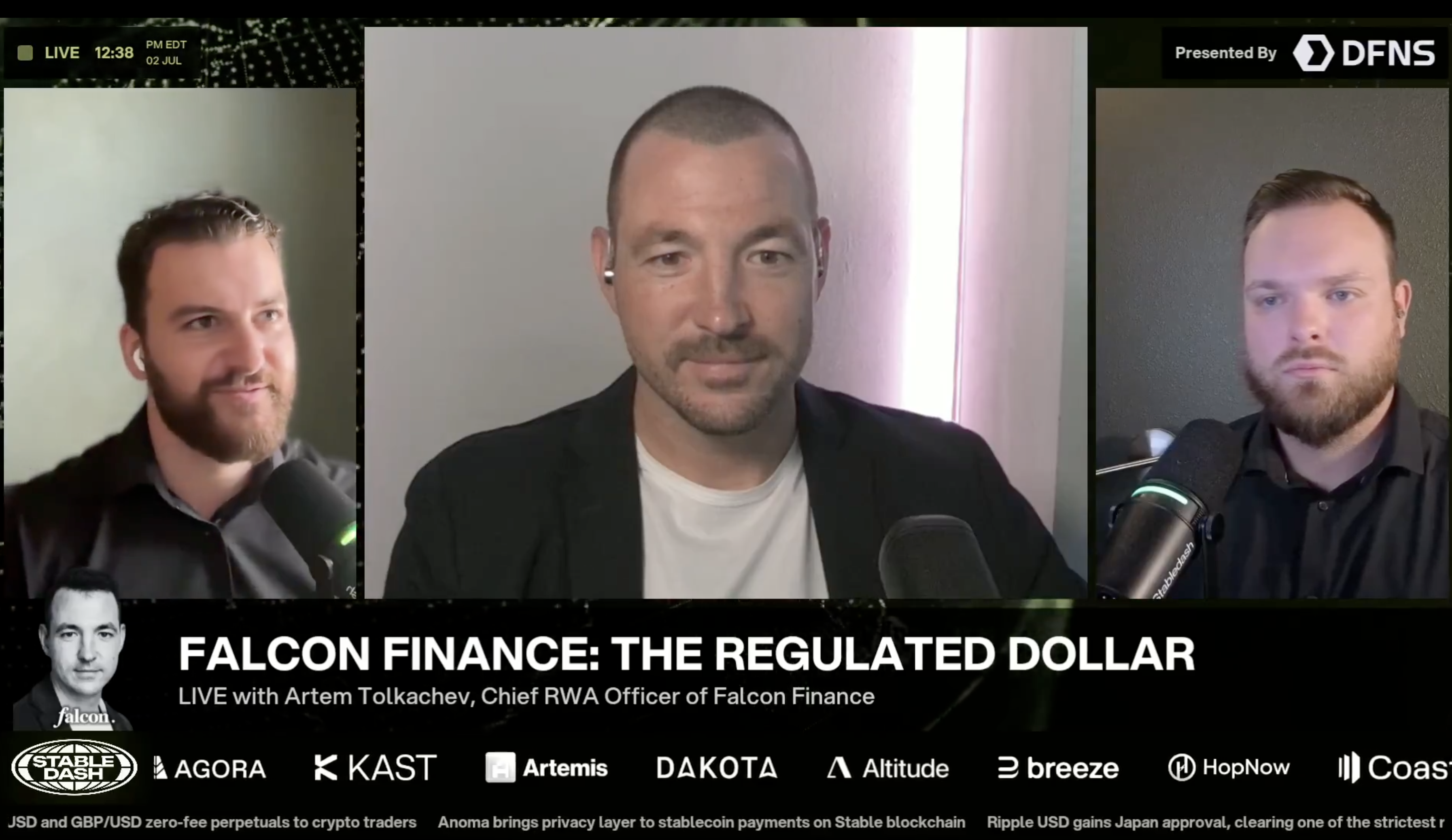
Falcon Finance Chief RWA Officer Artem Tolkachev joined Stabledash Live, The Modern Money Show hosted by Drew Rogers and Zach Fowler, on July 2. The conversation covered his path from a lawyer to collateral infrastructure builder, why USDf and fUSD serve different needs, and what the divergence between tokenized RWAs and Bitcoin says about the next phase of onchain finance. Quotes lightly edited for clarity.
A lawyer who never left crypto
Artem has been in crypto since 2013, when he published one of the first legal papers on Bitcoin. His law firm was later acquired by Deloitte, where he built a digital assets advisory practice for banks, regulators, and businesses.
His takeaway from that era was simple: raising capital through tokens is powerful, but investors need something more tangible behind them. So in 2018 he built a platform for issuing and trading tokenized securities. By 2021, that work had evolved into a yield-bearing stablecoin backed by corporate bonds. The project wound down in summer 2022, partly for geopolitical reasons, but it left him with the thesis that now drives his work at Falcon.
"Putting an asset onchain means nothing by itself. It was possible in 2018, and it's even more possible now. But if the asset isn't working onchain, if it's just sitting there, it doesn't mean anything."
As Chief RWA Officer, Artem's job is closing that gap: onboarding tokenized Treasuries, CLOs, corporate credit, tokenized gold, and tokenized stocks as productive collateral in Falcon's stack.
Tokenization is the engine. Collateralization is the product.
Asked what actually happens once real-world assets arrive onchain, Artem was direct.
"Tokenization is basically a back-end engine. The product is collateralization and liquidity. If an RWA comes onchain and just sits there, and only five wallets can touch it, it doesn't make much sense."
Falcon's answer is a universal collateralization layer. "It doesn't matter what type of asset you're working with. If we can price your asset and build a risk-reward model on top of it, we can accept it as collateral and provide liquidity against it."
How the Falcon flow works
Users deposit eligible collateral, whether stablecoins, Bitcoin, ETH, or tokenized assets. They mint USDf. Then they can stake USDf into sUSDf, which earns yield from a diversified set of market neutral strategies: funding rate arbitrage in both directions, cross-exchange arbitrage, staking, and options strategies, well beyond the basis trade.
Artem contrasted this with traditional DeFi lending.
"On a normal lending market, you borrow against your asset and pay interest. On Falcon, you unlock liquidity from your assets, and that liquidity earns."
The model has already scaled, with USDf passing $1.3 billion in circulation.
Who is minting USDf
Falcon's core client base is crypto institutions and other large holders that already manage collateral across exchanges and DeFi. The minting structure reflects that audience. Classic Mint starts at $10,000, while Innovative Mint is at $50,000, depending on the setup. Bitcoin was the largest collateral category at the time of the conversation.
"We don't want to cover every user in the world," Artem said. "We have a straightforward pitch for the market we serve. We understand their needs, and we help them."
Two dollars, two jobs
The hosts raised a point: why does Falcon run both USDf and fUSD?
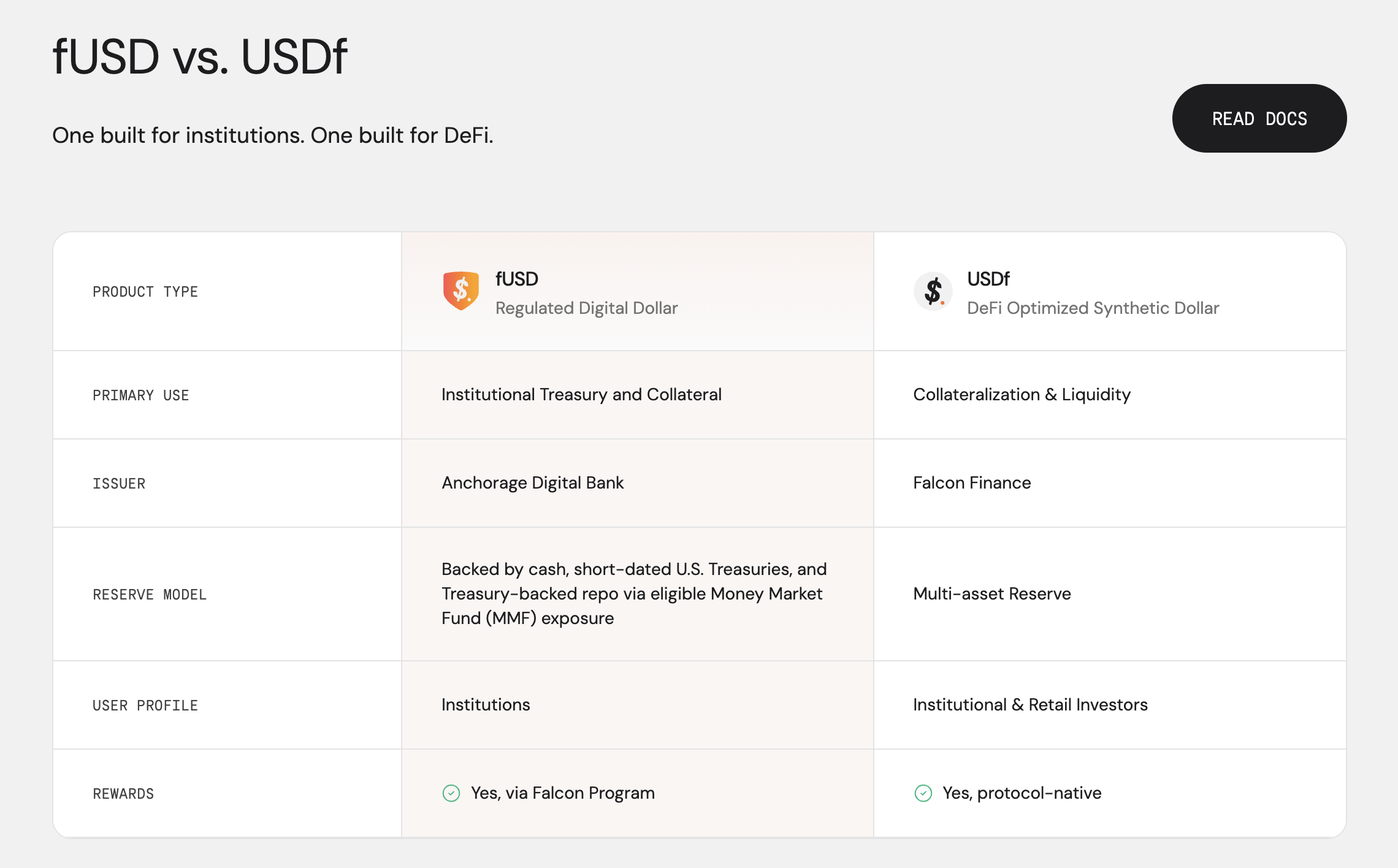
Because they are structurally different assets for different jobs. USDf is Falcon's overcollateralized synthetic dollar, built for DeFi-native liquidity and yield. fUSD is a GENIUS-ready regulated stablecoin issued by Anchorage Digital Bank, with reserves under OCC supervision and attested monthly by Deloitte, designed to be held and posted as collateral on centralized venues.
"If you're a trading company dealing with crypto assets on centralized exchanges, you want an asset that earns additional yield and is accepted as collateral, so it boosts your PnL. That's fUSD. If you hold volatile assets, crypto or RWAs, and you want liquidity or yield on top, that's USDf."
Same client category. Different use case. In some cases, the same organization uses both.
The quiet decoupling
The hosts pulled up a chart Falcon had shared: over the same 18-month period, Bitcoin's market cap fell 33% while tokenized RWAs rose 480%.
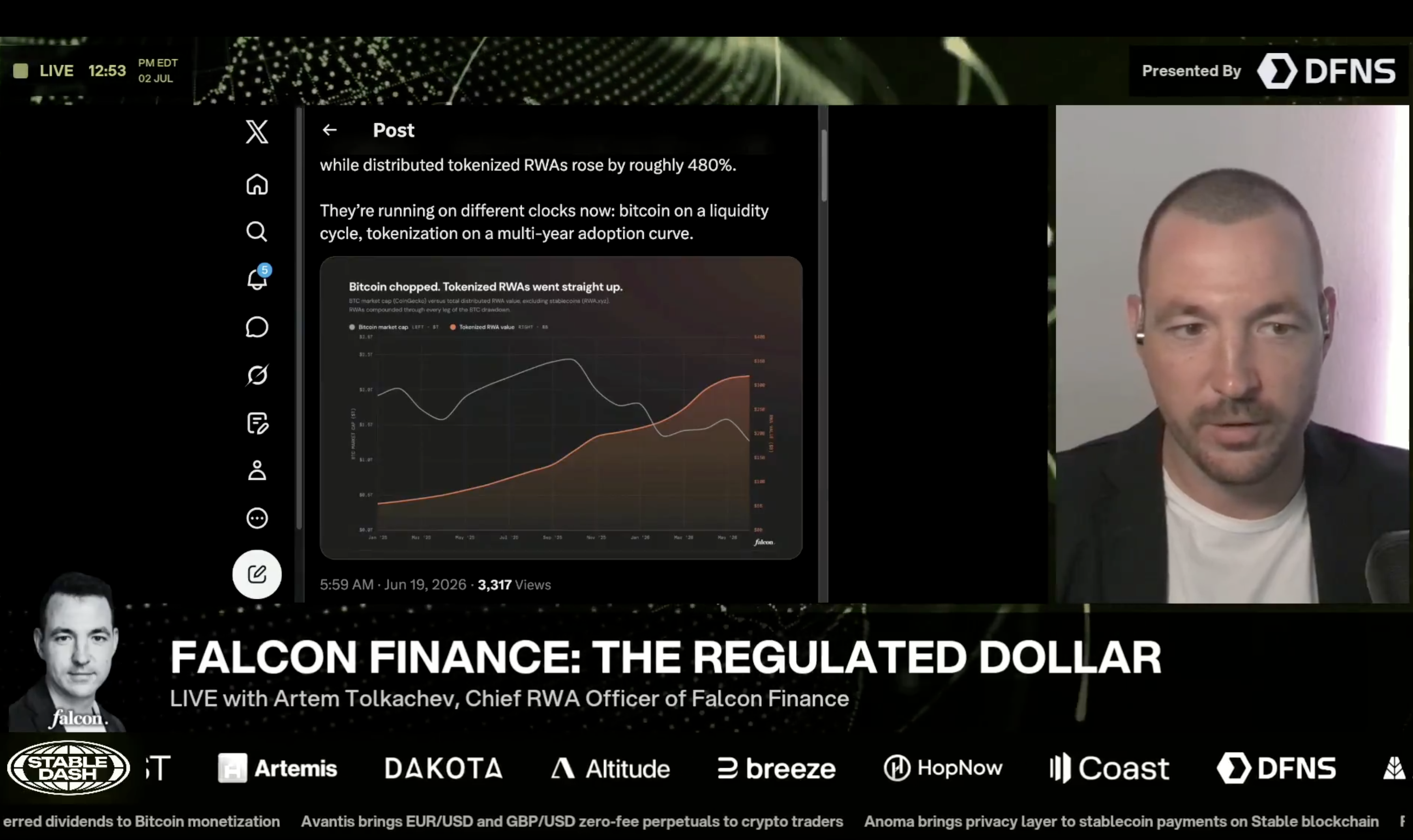
Artem's read is that the rails now exist, but the infrastructure still needs to adapt so tokenized assets can be used in crypto, rather than sitting in a small number of wallets. "For us, this chart confirms the thesis. We're still quite early with TradFi coming onchain, and we'll see much more volume." He pointed to developing regulatory frameworks, including the CLARITY Act, as one factor that may accelerate that shift.
The next wave of RWA infrastructure
As more real-world assets move onchain, Artem expects the infrastructure around them to grow fast this year and next: protocols built for collateralization, leverage, looping, and other DeFi-based use cases for tokenized assets. Issuance was the first step. Usefulness is the market that comes after it.
One stablecoin will not fit all
Artem also sees the stablecoin market specializing. Instead of one stablecoin for every use case, he expects products built for specific audiences: trading desks, regulated venues, DeFi-native users, tokenized asset markets.
On consortium efforts like Open USD: "A great initiative, but maybe too many players inside. I've been involved in projects with a lot of stakeholders. It usually gets messy when you need to decide on major issues."
In his view, the next wave will compete on improving PnL for holders. Stablecoins without economic sharing can still exist, but as TradFi brings more volume onchain, most of it will flow into dedicated instruments rather than defaulting to the incumbents.
The full stack
Artem's close was Falcon's pitch in one line: full stack infrastructure for any type of collateral, crypto or tokenized RWA, volatile or yield-bearing, turned into liquidity that works.
Watch the full episode on Stabledash Live, Artem's segment starts at 34:25.