March 2026: USDf Holds Steady at $1.63B Supply as Tokenized Equities Cross $1B Milestone
Published • 30 Mar 2026
4 mins
.jpg%3Fprefix%3Dmedia&w=3840&q=75)
In March 2026, we continued building out our universal collateral infrastructure, and USDf held strong with healthy overcollateralization even as markets shifted around us. A big theme this month: synthetic dollars aren't just stable, they're productive, and tokenized equities are proving their value as real DeFi collateral. We kept up our regular transparency updates and dug into what RWA composability actually looks like in practice, because capital efficiency only matters if people are using it.
USDf & sUSDf Updates
.png?prefix=media)
As of March 30, USDf supply sits at $1.63 billion, with $85.18 million in sUSDf. Total reserves are $1.76 billion, putting us at a 107.93% backing ratio, confirmed by HT Digital's latest attestation on March 27. sUSDf is delivering 5.58% APY.
- Where the reserves sit: BTC dominates at 59.8% ($1.05 billion), followed by MBTC (14.0%), ENZOBTC (11.9%), ETH (6.25%), and smaller allocations across stablecoins and other assets.
- How yield gets generated: Options-based strategies make up 61% of the approach, with positive funding farming and staking at 21%, and the rest in arbitrage and volatility plays.
- On custody: 93.6% sits in multisig wallets, with the remainder split between Fireblocks and Ceffu.
Key Announcements
sUSDf Delivers $21.36 Million in Total Yield
.png?prefix=media)
Just 11 months since our public launch, sUSDf has distributed $21.36 million in yield to stakers. Returns come from diversified reserve strategies, not token inflation, and the protocol keeps that process transparent.
Ecosystem Growth & Partnerships
xStocks: Unlocking Yield Opportunities for Tokenized Stocks
We broke down how xStocks works with Falcon: tokenized equities and ETFs like SPYx, NVDAx, and TSLAx can now serve as collateral for minting USDf. That means users keep their market exposure while unlocking liquidity and earning yield. The SPYx Staking Vault adds roughly 3% APR in USDf rewards on top of index exposure, with a lockup period. [Read the full overview]
The bigger picture: tokenized equities crossed $1 billion in onchain value in March, up 33x in 14 months, with transfer volumes to match. Our work with xStocks and ongoing conversations with partners like Centrifuge reflect where we think this is heading: RWAs that actually do something in DeFi, not just sit there.
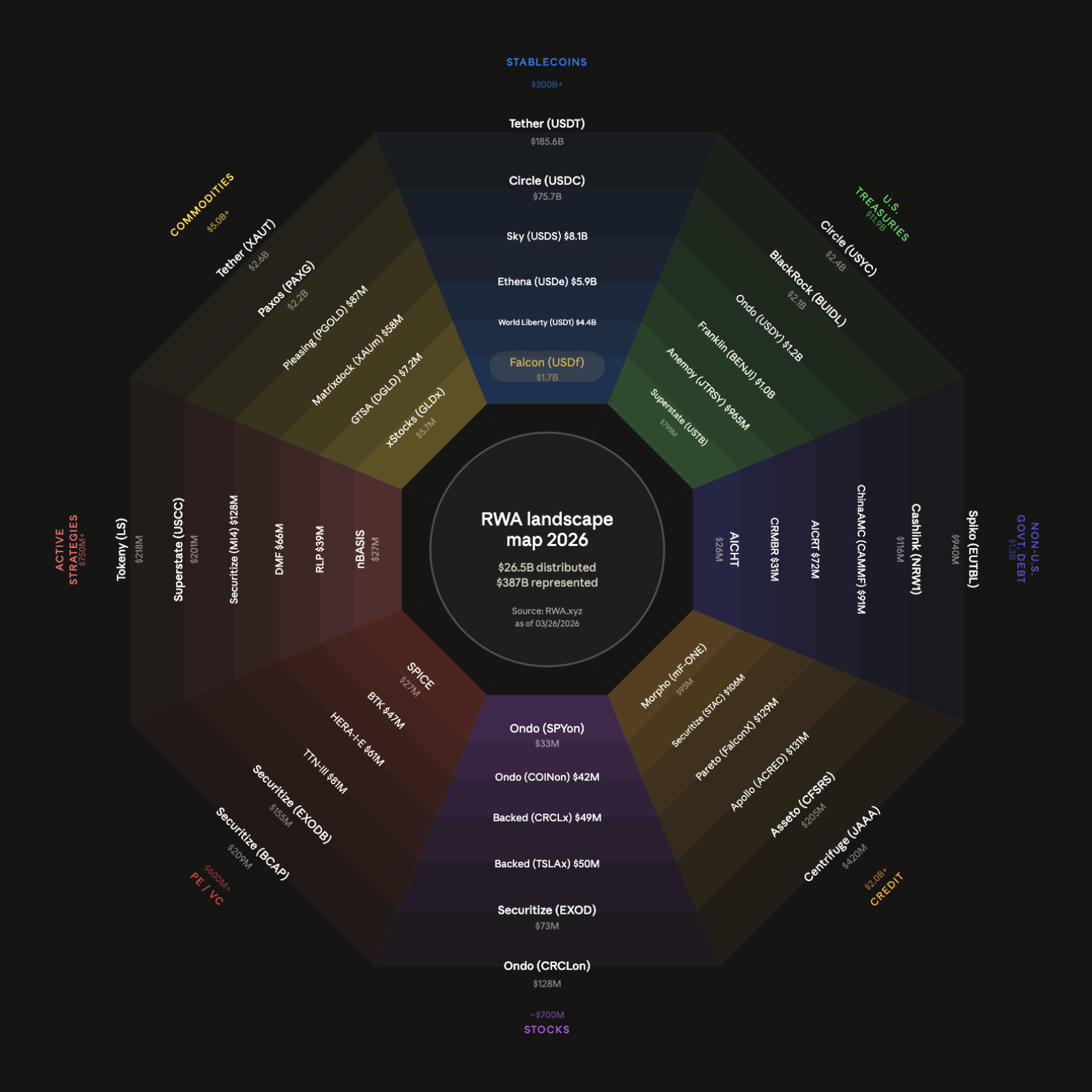
The current RWA landscape map
- Stablecoins are still taking the lead with nearly $300B market cap, with USDT and USDC accounting for 86.7% combined market share
- Tokenized U.S. Treasuries is the second highest category with $12.3B total value
- Followed by tokenized commodities (incl. gold, oil, and diamonds) at a $7.1B market cap, tokenized credit at $6B in total value, non-U.S. government debt at $1.3B, and tokenized stocks at around $930M
Media Engagement and AMAs
CoinDesk: How DeFi is quietly rebuilding the fixed-income stack for institutional capital
Andrei Grachev, Managing Partner at DWF Labs and Founding Partner at Falcon Finance, authored an opinion piece exploring programmable yield and DeFi’s role in serving institutional capital beyond simple tokenization. Source
2026 RWA Tokenization Trends
Our Chief RWA Officer Artem Tolkachev joined experts from Centrifuge, xStocks, and DWF Labs in a deep dive on what it actually takes to use RWAs as DeFi collateral: reliable pricing, real liquidity, composability, and usability. The full report covers where the industry is heading in 2026. Source
The Off-Ramp Problem: Why Onchain Dollars Still Can’t Pay the Bills
Artem Tolkachev was featured in FinTech Weekly on one of the industry's stickiest problems: stablecoin off-ramps. Source
What's Next?
March was about doing the work: delivering yield, staying transparent, and proving that tokenized assets can function as real collateral. Looking ahead, we're pushing deeper into RWA integrations, deploying more from our ecosystem fund, and expanding what productive onchain capital looks like. The goal for 2026 hasn't changed: build the capital-efficient infrastructure that synthetic dollars need.
Tags